
The Great Wage Divergence
When Numerical Results Are Highly Dependent Upon Parameter Choices, Inequality Likely Remains The Baseline


With the affordability crisis in the background, there remains real discussions about trends not just in prices —but also in wages. And within the broader wage-inequality literature, Professor Arin Dube’s latest contribution, builds on joint work with David Autor and Annie McGrew, and lands somewhat in the middle of a long-running empirical and methodological contest over what has happened to wage dispersion in the United States, for whom, and how confidently economists can measure it.
Even before the pandemic, scholars debated the magnitude and timing of inequality’s rise across data sources and pay concepts (wages versus total compensation, hourly versus weekly earnings, administrative versus survey data), and amongst academics there has been some persistent disagreement over exactly how best to handle technical issues, like top-coding, nonresponse, changing workforce composition, and the distinction between cross-sectional levels, within-person growth, and so on. That methodological pluralism matters because it shapes the interpretation of lived economic pressure, and as affordability strains intensify for many households, public-facing arguments about whether “pay has kept up,” and whether inequality is widening or narrowing, increasingly hinge on exactly which series one trusts and what it is designed to capture.
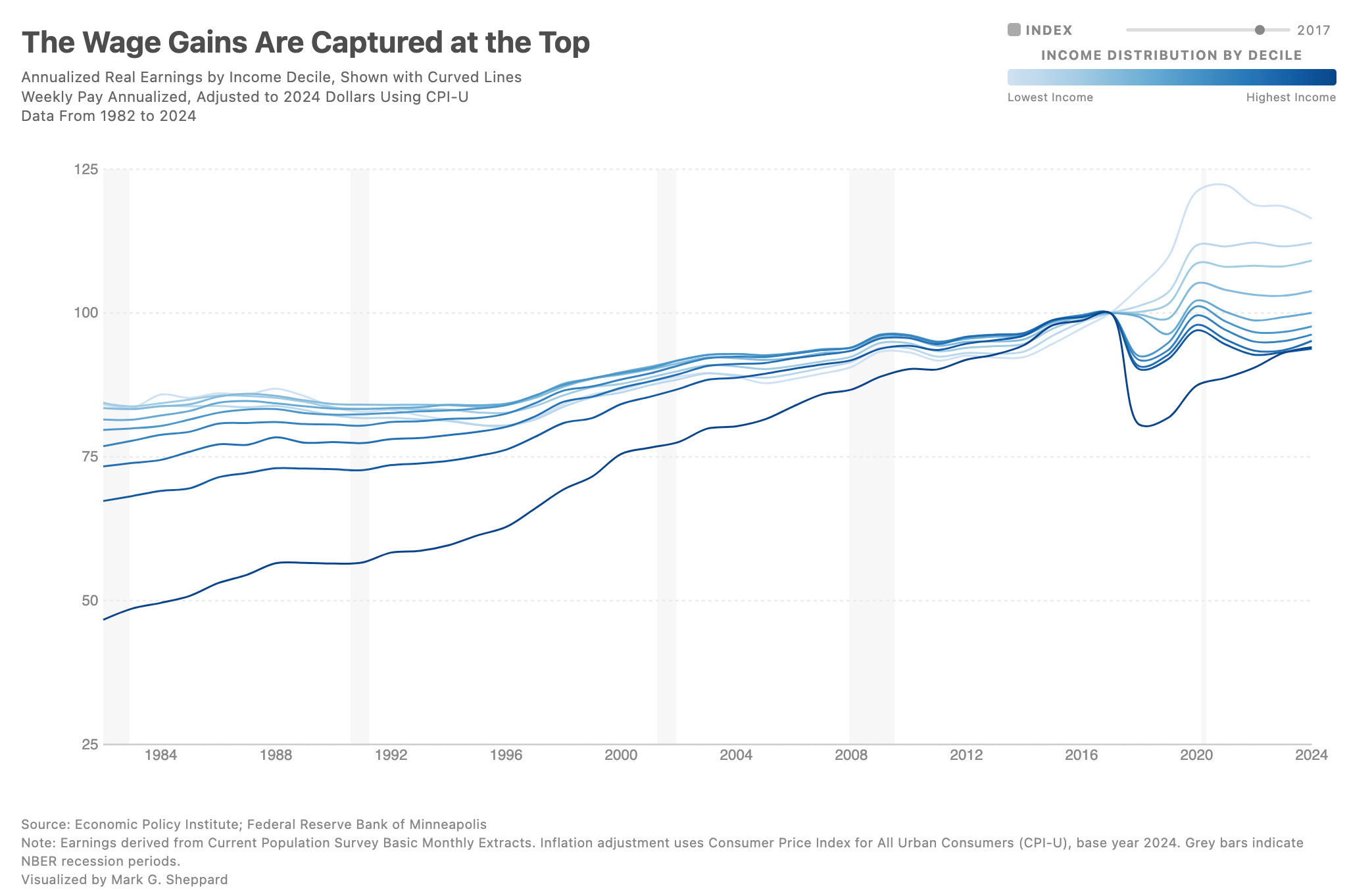
While their analysis finds meaningful wage compression over the period they emphasize, a closer look at the same underlying series indicates that the strength and presentation of the result can be sensitive to reasonable parameter choices, especially the indexing baseline; in the interest of transparency, I built an interactive tool that lets readers vary these choices and see directly when the compression conclusion holds most clearly and when the pattern looks more consistent with the longer-run divergence narrative.
Against that contested backdrop, the “wage compression” result stands out precisely because it is so out-of-character for the post-1980 stylized fact that wage gains have been disproportionately concentrated at the top while lower-end wages lagged or stagnated. The Dube–Autor–McGrew finding—that during and after the pandemic the lower tail experienced unusually rapid wage growth and key dispersion measures (e.g., 50–10 and 90–10 gaps) fell—both disrupts the default narrative and invites unusually broad scrutiny. As Dube emphasizes in this update, the point is not a triumphalist claim that inequality “is solved,” but a far more disciplined reading of what the data through November 2025 can support: the bottom’s relative gains largely persist, while also showing a worrying deceleration in real wage growth at the bottom in 2025 and carefully distinguishing cross-sectional distributional shifts from within-person wage growth metrics.
That combination, of an empirically salient break from trend, paired with clear interpretive boundaries, helps explain why the work attracted attention from very different constituencies and was often pulled into arguments that go beyond what the authors themselves claim.
On one side, many readers sympathetic to labor-market institutions and demand-side policy leaned on the compression episode as suggestive evidence that tight labor markets, stronger outside options, and intensified competition for low-wage workers can deliver distributional gains at the bottom—and therefore that maintaining full employment conditions (and adjacent policy frameworks) should be an explicit objective.
On the other side, some commentators with more traditional supply-side priors have cited the same findings as a counterweight to sweeping claims of relentless divergence, using the compression episode as a proof of concept that inequality narratives can be overstated or overly static. Read in context, Dube’s own framing is more circumscribed than either appropriation: the evidence documents an unusual, historically rare compressive shift that persisted through late 2025, while explicitly cautioning that its durability depends on labor-market slack and that the most recent year shows signs of vulnerability at the bottom—precisely the segment whose gains are most sensitive to a meaningful cooling in employment conditions.
Professor Dube, together with David Autor and Annie McGrew, has produced a careful and influential contribution to the post-pandemic wage inequality debate. The work is commendable not only for the clarity of its empirical presentation, but also for its seriousness about measurement concerns such as composition adjustment and the distinction between cross-sectional wage levels and within-person wage growth. At the same time, a fair reading of the findings underscores that their force depends not only on cross-sectional percentiles, but on a more specific set of analytical choices that discipline how the time series is interpreted. In particular, the compression narrative is tightly linked to the index choice used to present cumulative changes. Because the figures are framed as wages relative to a baseline year, the baseline becomes an organizing premise for the story: it determines what is treated as the reference point for “how much has changed” and for whom.
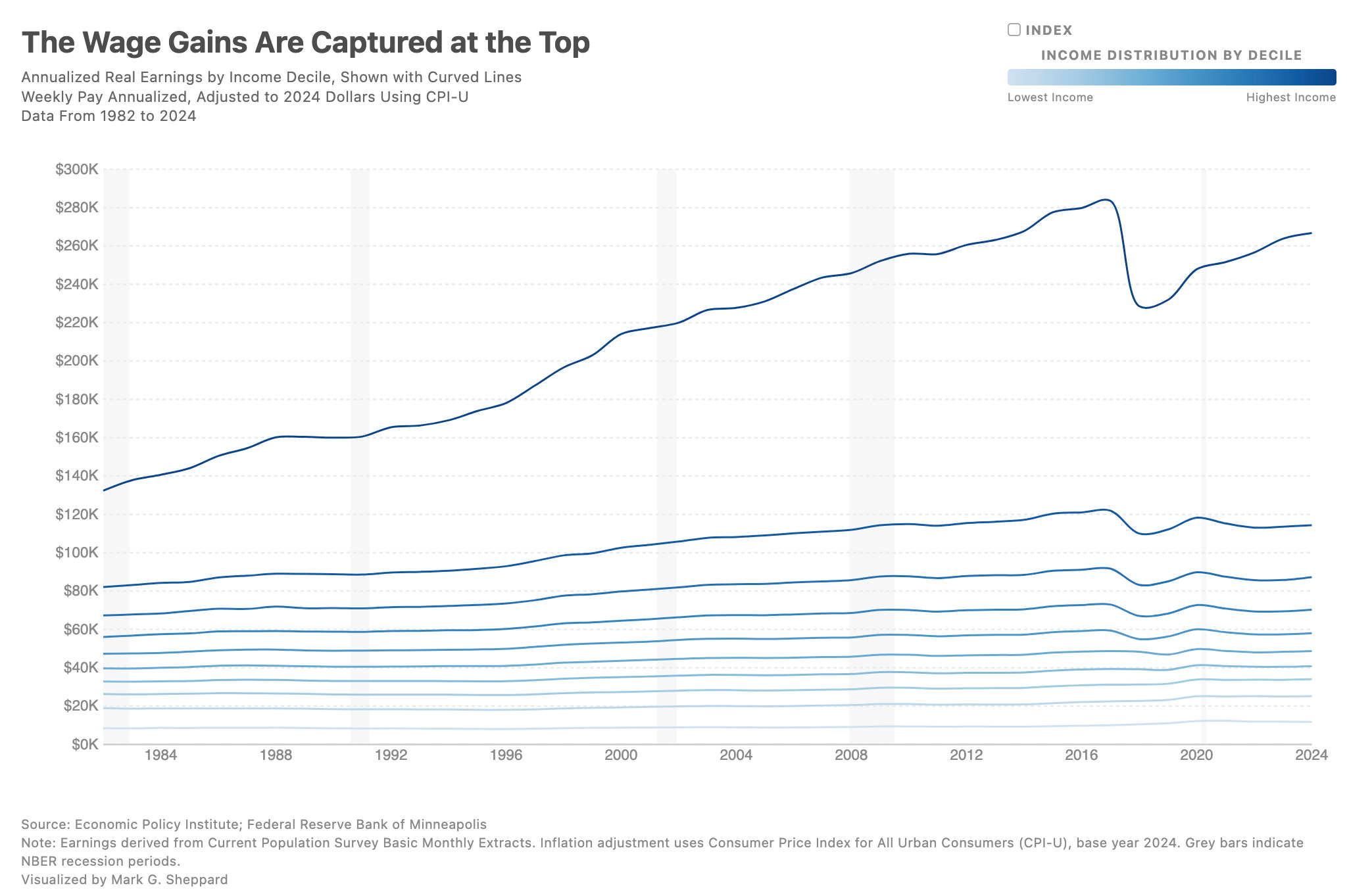
A key methodological point is that the interpretation of these percentile series can be highly sensitive to framing choices, especially the indexing baseline. Using the authors’ baseline, the compression pattern is clear, but alternative baselines or unindexed presentations can make the same data look closer to the familiar story of divergence. This does not negate the result, but it underscores how parameter choices can shape what readers take to be the dominant trend.
At a time when many Americans feel squeezed by high costs and uneven gains, it is easy for public discussion to turn a short-run pattern into a broad story about what is happening to living standards. That is not a problem with any one study. It is a general risk that comes with translating technical results into headlines, talking points, and policy arguments. The responsible approach is for everyone in the conversation to be clear about what a finding does and does not show, including how the picture can depend on parameter choices. To be clear, inequality remains a major long-run issue.